kardio.az

Mechanical Indications for Anticoagulation

Dr. Kənan Əhmədov2 dəq oxu
Mechanical Indications for Anticoagulation

Anticoagulation after valve surgery is one of those areas where the answer is never a single INR number. It depends on which valve was implanted, where it sits, whether the patient carries additional thrombotic risk, and how long ago the operation was. The chart below collects those decisions in one place.

What the chart covers

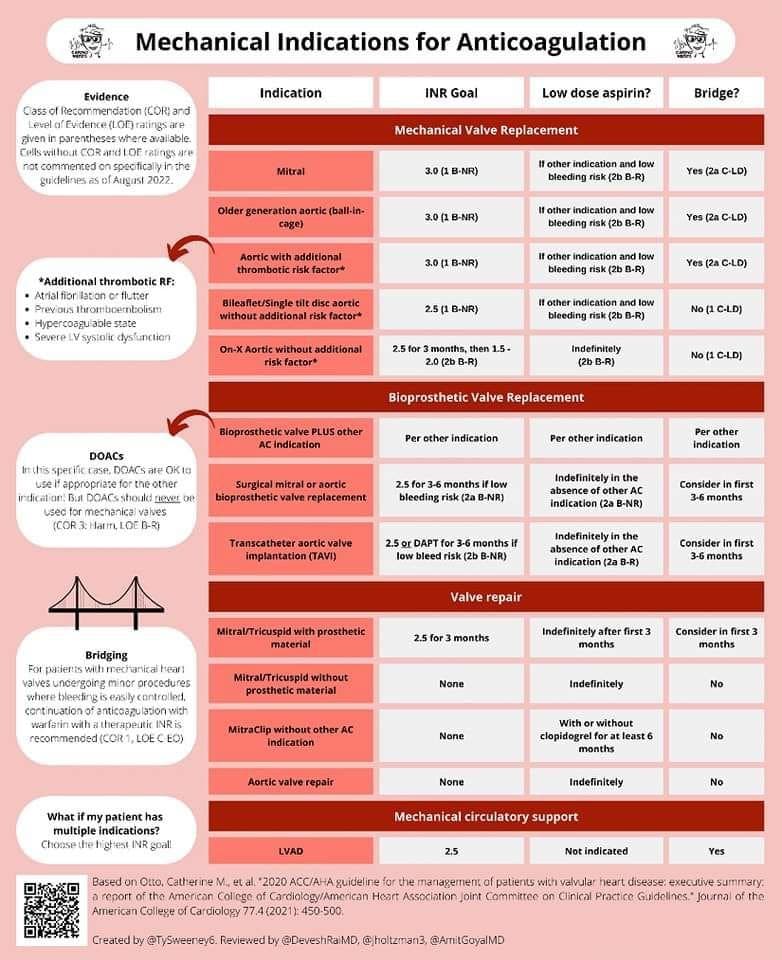
It is organised by intervention type — mechanical valve replacement, bioprosthetic valve replacement, valve repair, and mechanical circulatory support — and for each gives the INR goal, whether low-dose aspirin is indicated, and whether bridging is appropriate. Class of Recommendation and Level of Evidence ratings are shown in parentheses where the guideline provides them.
Points worth keeping in mind

  • Mechanical valves. Mitral and older-generation aortic prostheses target an INR of 3.0; a bileaflet or single tilting-disc aortic valve without additional thrombotic risk factors targets 2.5. The additional risk factors that move a patient up are atrial fibrillation or flutter, previous thromboembolism, a hypercoagulable state, and severe left ventricular systolic dysfunction.
  • DOACs and mechanical valves do not mix. Direct oral anticoagulants carry a Class 3 (Harm) recommendation in mechanical prostheses. Where a bioprosthetic valve patient has a separate DOAC indication, the DOAC is dosed for that other indication.
  • Bioprosthetic valves are generally anticoagulated for a limited window — 3 to 6 months after surgical mitral or aortic replacement in patients with low bleeding risk — rather than indefinitely.
  • Bridging. For mechanical valve patients undergoing minor procedures where bleeding is easily controlled, continuing warfarin at a therapeutic INR is recommended rather than interrupting it.
  • Multiple indications? Take the highest INR goal.

The summary is built on the 2020 ACC/AHA guideline for the management of patients with valvular heart disease. It is a quick reference, not a substitute for the full document — check the current text before applying it to an individual patient.

Mechanical indications for anticoagulation — INR goals, aspirin and bridging by valve type, based on the 2020 ACC/AHA valvular heart disease guideline

Şərhlər

İlk şərhi siz yazın

Şərh yazın

Şərhlər dərc olunmazdan əvvəl yoxlanılır. E-poçtunuz göstərilmir.